Immunoassay
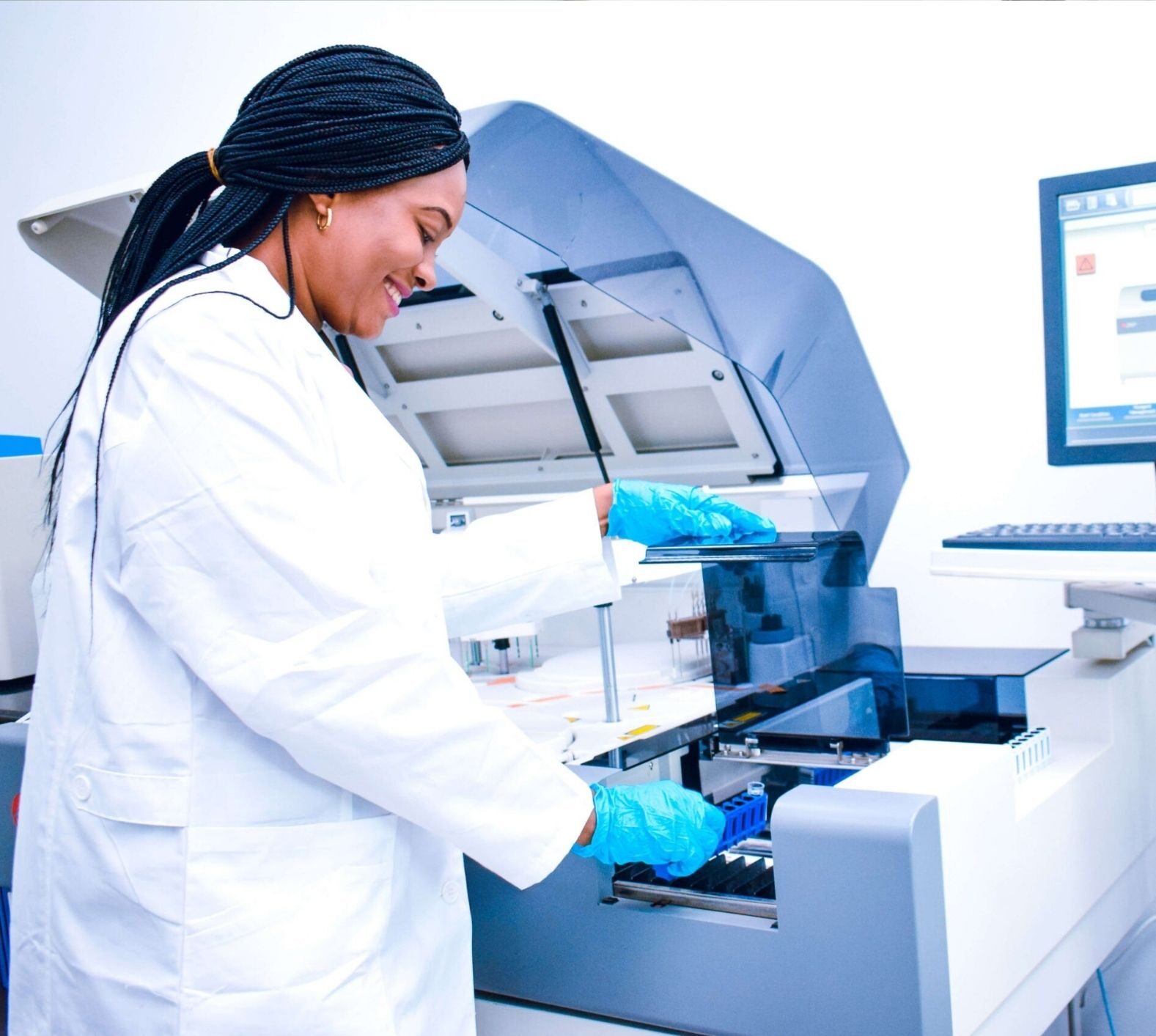
MUDC and MKDC provide trusted immunoassay services. Immunoassay tests are used to test for the presence of an antibody in a blood or fluid sample. An immunoassay test contains a specific antigen and if the antibody is present in the sample, it will react or bind with the antigen in the test system and the disease or disorder will be detected as positive.
Immunoassays are used to test for: The presence of drugs, The presence of drugs, Pregnancy, Heart disease, Tumour markers, Markers of cardiac injury, Hypoglycemia, Prostate cancer, Meningitis, Viral hepatitis, HIV, Lyme disease, Chlamydia trichomatis, Rheumatoid arthritis. There are several different methods used in immunoassay tests.
Immunoprecipitation
The simplest immunoassay method measures the quantity of precipitate, which forms after the reagent antibody has incubated with the sample and reacted with its respective antigen to form an insoluble aggregate. Immunoprecipitation reactions may be qualitative or quantitative.
Particle Immunoassays
By linking several antibodies to the particle, the particle is able to bind many antigen molecules simultaneously. This greatly accelerates the speed of the visible reaction. This allows rapid and sensitive detection of antibodies that are markers of such diseases, as infectious mononucleosis, and rheumatoid arthritis.
Immunonephelometry
The immediate union of antibody and antigen forms immune complexes that are too small to precipitate. However, these complexes will scatter incident light and can be measured using an instrument called a nephelometer. The antigen concentration can be determined within minutes of the reaction.
Radioimmunoassay (RIA)
Radioimmunoassay (RIA) is a method using radioactive isotopes to label either the antigen or antibody. This isotope emits gamma rays, which are usually measured following removal of unbound (free) radiolabel. The major advantages of RIA, compared with other immunoassays, are higher sensitivity, easy signal detection, and well-established, rapid assays. The major disadvantages are the health and safety risks posed by the use of radiation and the time and expense associated with maintaining a licensed radiation safety and disposal program. For this reason, RIA has been largely replaced in routine clinical laboratory practice by enzyme immunoassay, explained below.
Enzyme Immunoassay (EIA)
Enzyme Immunoassay (EIA) was developed as an alternative to radioimmunoassay (RIA). These methods use an enzyme to label either the antibody or antigen. The sensitivity of EIA approaches that for RIA, without the danger posed by radioactive isotopes. One of the most widely used EIA methods for detection of infectious diseases is the enzyme-linked immunosorbent assay (ELISA).
Fluorescent Immunoassay (FIA)
Fluorescent Immunoassay (FIA) refers to immunoassays which utilize a fluorescent label or an enzyme label which acts on the substrate to form a fluorescent product. Fluorescent measurements are more sensitive than colorimetric (spectrophotometric) measurements. Therefore, FIA methods have greater sensitivity than EIA methods, which use absorbance measurement.
Chemiluminescent Immunoassays
Utilize a chemiluminescent label. Chemiluminescent molecules produce light when they are excited by chemical energy. These emissions are measured by a light detector.